

Total Stations
Total stations are precision surveying instruments used to measure angles, distances, and coordinates in construction and engineering projects. By combining electronic distance measurement with an integrated theodolite, these systems allow surveyors to capture accurate positional data and establish reliable control points across a site.
These systems are widely used in construction, civil engineering, and infrastructure development, where accurate layout and measurement are essential. On projects that also involve digital site capture, 3D scanning may be used alongside total stations to document existing conditions and support wider project coordination.
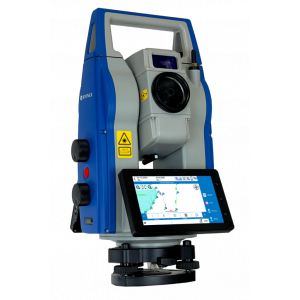
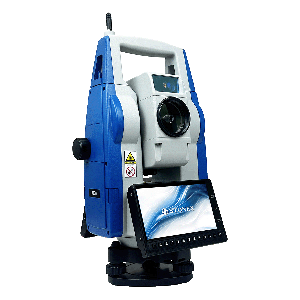
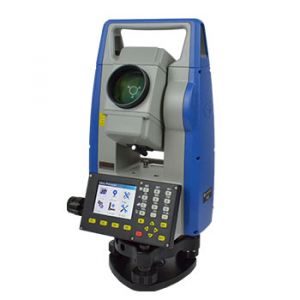
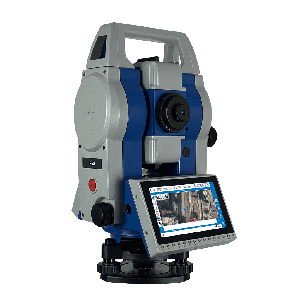
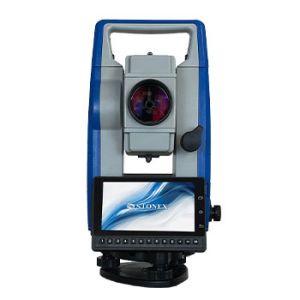
What Is a Total Station
A total station is an electronic surveying instrument that measures horizontal and vertical angles together with distance to a target point. These measurements are processed by the instrument’s onboard software to calculate precise coordinates for each surveyed point.
In total station surveying, the instrument is typically mounted on a tripod and aligned with a known reference point. Measurements are taken either using a reflective prism or through reflectorless distance measurement technology. The collected data can then be stored within the instrument and exported for further processing.
Because the system combines angle and distance measurement in a single instrument, total stations allow surveyors to complete complex site measurements with a high degree of accuracy and efficiency.
Types of Total Stations
Different types of surveying instruments are available depending on the requirements of the project and the level of automation needed.
Conventional systems require an operator to manually aim the instrument at a prism or target point. These systems are commonly used for general surveying tasks and construction layout work.
Robotic total station systems automate the measurement process by tracking a prism carried by the surveyor. This allows a single operator to complete measurements that would traditionally require two people.
Modern instruments may also include reflectorless distance measurement, which enables the operator to measure points without the use of a prism. This capability is particularly useful when measuring building facades, structures, or areas that are difficult to access.
Applications in Surveying and Construction
These instruments are widely used across a range of surveying and construction applications. During the early stages of a project, they help establish site control and record the existing ground conditions before development begins.
In construction environments, total station surveying supports tasks such as setting out building positions, aligning structural elements, and verifying dimensions during the build process. Depending on the task, contractors may also use laser levels to support levelling and alignment work across the site. Accurate measurements ensure that structures are positioned according to design specifications.
Infrastructure and civil engineering projects also rely on these systems to monitor alignment, measure distances across large sites, and maintain consistent measurement control throughout the project lifecycle.
Accuracy and Measurement Capabilities
Accuracy is one of the most important factors when selecting surveying instruments for professional use. High-quality instruments provide precise angle measurements and reliable distance readings, ensuring consistent results across repeated site surveys.
Many modern systems include reflectorless measurement technology, allowing surveyors to capture points on surfaces without placing a physical target. This improves efficiency and allows measurements to be taken in locations where access may be limited.
Data collected by the instrument can be transferred to survey software for further analysis, modelling, and project documentation.
Choosing the Right Total Station
Selecting the appropriate system depends on the scale of the project and the level of measurement capability required. Smaller construction projects may use conventional instruments for basic site layout, while larger infrastructure projects often benefit from robotic total station technology that allows faster data collection.
Other factors to consider include measurement range, accuracy requirements, and compatibility with existing surveying software.
At Celtic Surveys, we work with surveying and engineering professionals across Ireland to provide total stations suited to construction, infrastructure, and industrial applications. Choosing the right instrument ensures reliable measurements and efficient site workflows.
If you require further information on total station surveying equipment or guidance on selecting the appropriate system, Celtic Surveys can provide practical advice based on your project requirements. Call 01 801 1335 or email sales@celticsurveys.ie to speak with our team.